Light as a Spectrum
Visible light is electromagnetic radiation with wavelengths roughly between 380 and 740 nanometres. At the short end sits violet, and at the long end sits red, with the familiar rainbow of colours — violet, blue, cyan, green, yellow, orange, red — spread across that range. This is the spectrum as physics defines it: a continuous gradient of wavelengths, each one corresponding to a distinct energy of light.
When we talk about colour filters, we are fundamentally talking about devices that manipulate which parts of this spectrum are allowed to pass through to the camera sensor or film. Understanding filters properly requires understanding that not all colours behave the same way — some exist as real wavelengths of light, some exist only in the human mind, and some, remarkably, exist as both.
How Colour Filters Actually Work
A common misconception is that a colour filter has a sharp, binary action — that a red filter, for example, passes all wavelengths from 625 to 740nm and blocks everything else completely. In reality, filters have a transmission curve: a gradual slope that rises from near-zero transmission at blocked wavelengths, through a transition zone, to full or near-full transmission at the wavelengths it is designed to pass. There is no hard wall, only a slope — steeper in some filters, more gradual in others.
The mechanism behind this depends on the filter type. Absorption filters — the most common type used in photography — contain dyes that absorb certain wavelengths and convert the light energy to heat. The dye chemistry determines the absorption spectrum. Interference filters, more common in scientific instruments, use thin-film coatings that cause destructive interference for unwanted wavelengths, reflecting them rather than absorbing them. Interference filters can achieve much sharper cutoffs, sometimes transitioning from full blocking to full transmission within just a few nanometres.
Long-Pass and Short-Pass: The Geometry of Filtering
Photographic colour filters are almost always either long-pass or short-pass filters, not the narrow bandpass filters one might expect. A long-pass filter transmits wavelengths above a certain threshold and blocks those below it. A short-pass filter does the opposite. This is an important distinction because it means a red filter does not only pass red light — it passes red and also whatever lies beyond red (near-infrared), while blocking greens, blues, and yellows.
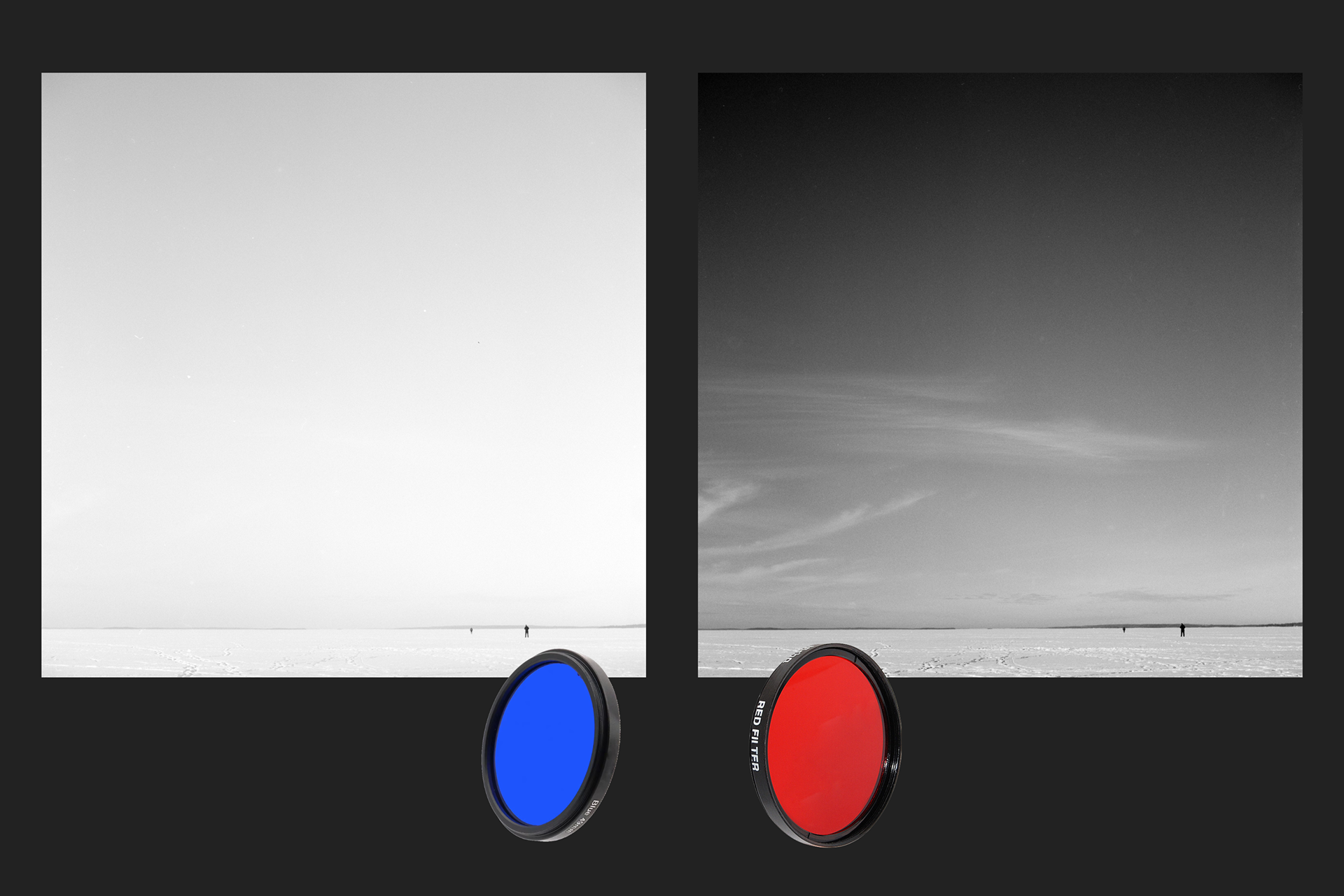
A red filter (such as the classic Wratten 25) begins transmitting from around 580nm, reaching 50% transmission at approximately 600nm and full transmission around 620nm. It blocks virtually all blue, green, and yellow — not just blue and violet as is sometimes assumed. In black and white photography, this has dramatic consequences: red subjects become very bright, blue skies go very dark, and the contrast between clouds and sky becomes extreme. The sky appears dark because it predominantly reflects blue light, which the red filter blocks almost entirely. Meanwhile red and orange subjects reflect wavelengths the filter passes freely, so they record as bright.
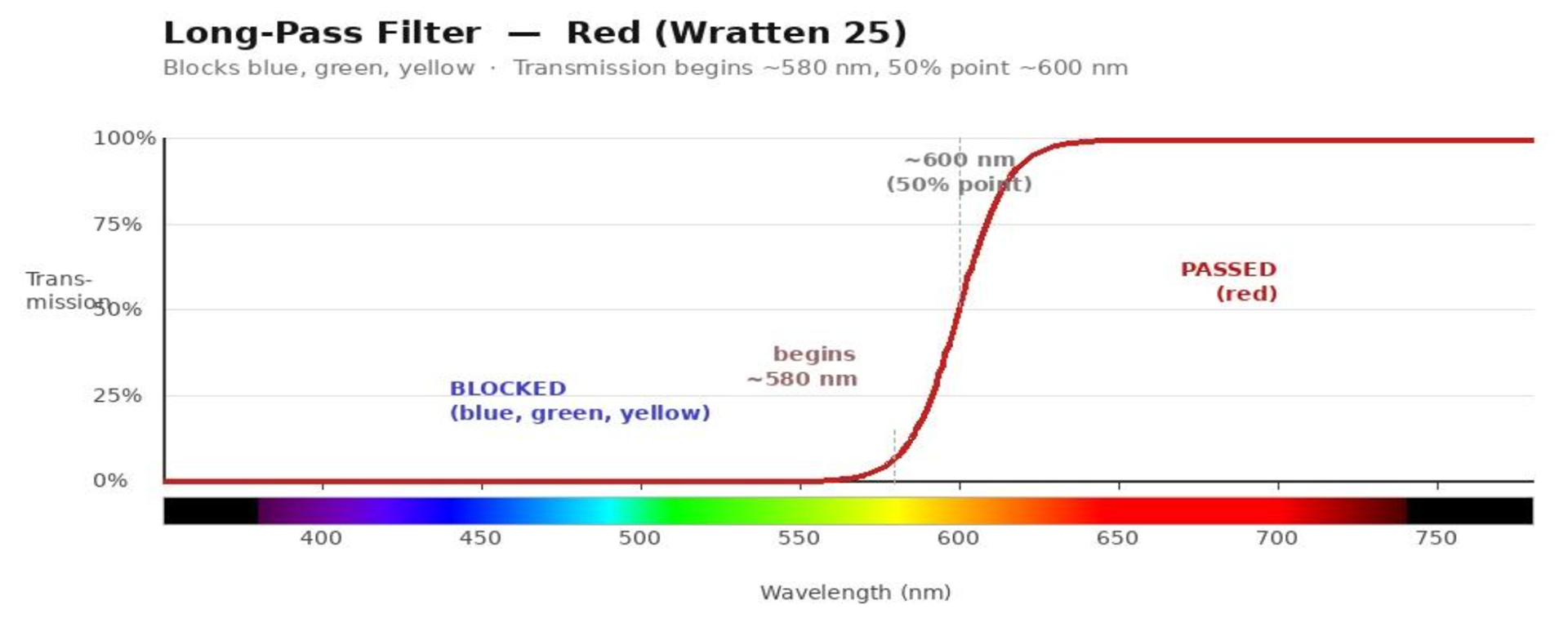
Figure 1: Long-pass filter (red, e.g. Wratten 25) — gradual transmission curve rising from ~580 nm
A yellow filter (such as the Wratten 8) is also a long-pass filter, beginning to transmit meaningfully from around 500nm upward. Despite its name suggesting a narrow slice of the spectrum, it passes yellow, orange, and red while attenuating greens and strongly blocking blues and violets. The effect in black and white photography is subtler than a red filter — a moderate darkening of blue sky and a slightly warmer, more natural rendering of skin tones and foliage.
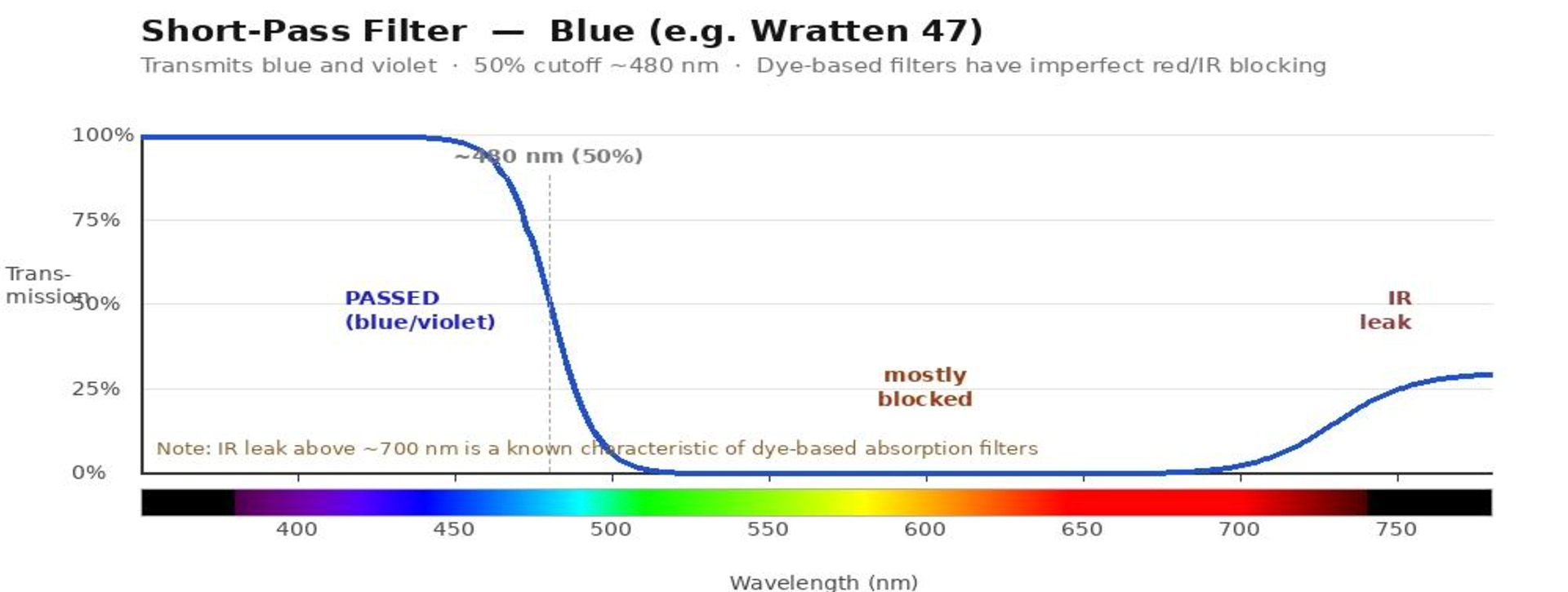
Figure 2: Short-pass filter (blue) — transmits below ~500 nm, blocks green, yellow and red
A blue filter such as the Wratten 47 is a short-pass filter — transmitting blue and violet while attenuating greens, yellows and reds. Its 50% cutoff falls around 480nm. It is the short-pass counterpart to the red filter's long-pass behaviour, though dye-based blue filters are imperfect at blocking the far red and infrared end. In black and white photography this darkens red and orange subjects strongly while having little effect on blue sky (which it passes). Because the Wratten 47 transmits only a narrow violet-blue band from roughly 400 to 475nm, it is more accurately described as a short-pass filter. The effect in black and white is considered less useful than red or yellow for most landscape work. Blue filters are more commonly encountered in colour correction work, such as balancing the warm, orange-cast light of tungsten bulbs to resemble cooler daylight.
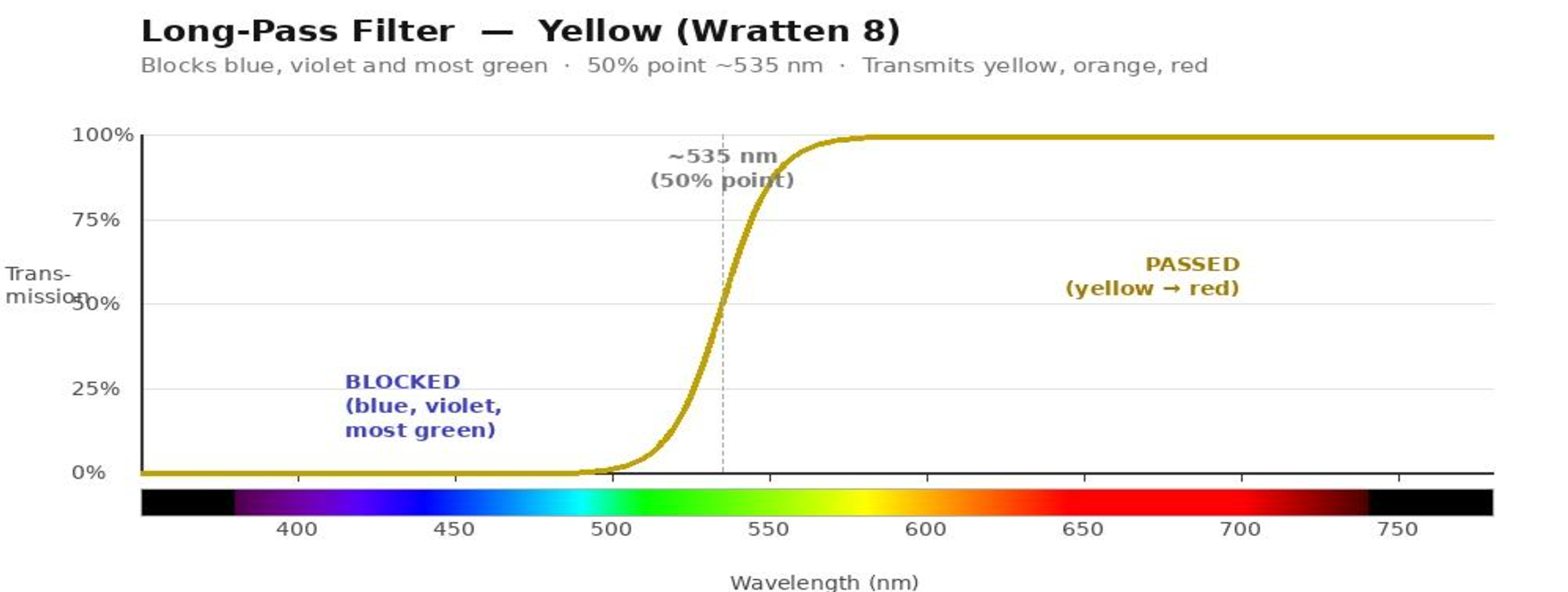
Figure 3: Long-pass filter (yellow, e.g. Wratten 8) — similar shape to red but shifted left, blocking only blue and violet
The Leaky Ends: UV and Infrared
There is a pleasing symmetry in how both ends of the spectrum cause problems for photographers. Blue filters, being short-pass, tend to also transmit ultraviolet light, which sits just beyond the violet end of the visible range. Since film and digital sensors are often sensitive to UV, this can introduce unwanted haze or exposure shifts unless a dedicated UV-blocking coating is also present.
At the other end, red filters and even unfiltered camera lenses can allow near-infrared light to pass. Digital sensors are highly sensitive to infrared — far more than the human eye — which is why virtually all digital cameras include a built-in infrared cut filter placed in front of the sensor. Without it, colours would be badly distorted and foliage would appear unnaturally bright (infrared photography deliberately removes this cut filter to achieve its distinctive, dreamlike look).
True Colours: When a Wavelength Really Exists
Not all colours are created equal, physically speaking. Some colours correspond to a specific, real wavelength of electromagnetic radiation. Red, orange, yellow, green, blue, cyan, and violet are all spectral colours in this sense — they appear in a rainbow, they can be produced by a prism, and each has a defined position on the spectrum measured in nanometres.
These are the colours that a filter can engage with directly at the physical level. When a red filter transmits 620nm light, it is working with a real, measurable wavelength. The physics is clean and straightforward.
The Invented Colour: Magenta Does Not Exist
Magenta is one of the most philosophically interesting things in the visible world — a colour that has no wavelength. Look at a rainbow carefully and you will see red, orange, yellow, green, blue, indigo, violet. Magenta never appears. No single wavelength of light, however you choose it, will produce the experience of magenta.
What magenta actually is, is a perceptual construction. The human eye detects colour using three types of cone cells, sensitive to long (red), medium (green), and short (blue) wavelengths. When your red cones and blue cones are stimulated simultaneously without any stimulation of the green cones, your visual system has a problem: these two signals are at opposite ends of the spectrum, with nothing connecting them. The brain, rather than reporting confusion, invents a colour to bridge the gap — and that invented colour is magenta.
This is why magenta, along with all purples and pinks, is called a non-spectral colour. The full range of human colour perception is often visualised as the CIE chromaticity diagram — a horseshoe shape. The curved outer edge of the horseshoe represents the pure spectral colours, real wavelengths from violet to red. But the straight bottom edge of the horseshoe — called the line of purples — represents all the non-spectral colours including magenta. This line has no physical counterpart in the wavelength spectrum. It exists only in the perceptual space the brain constructs.
For filter design, this has real consequences. A magenta filter cannot simply pass 'magenta wavelengths' because there are none. Instead, a magenta filter must transmit both the red end and the blue/violet end of the spectrum while blocking the green middle. This makes it technically a bandstop or notch filter — a more complex transmission curve than a simple long-pass red or short-pass blue filter.
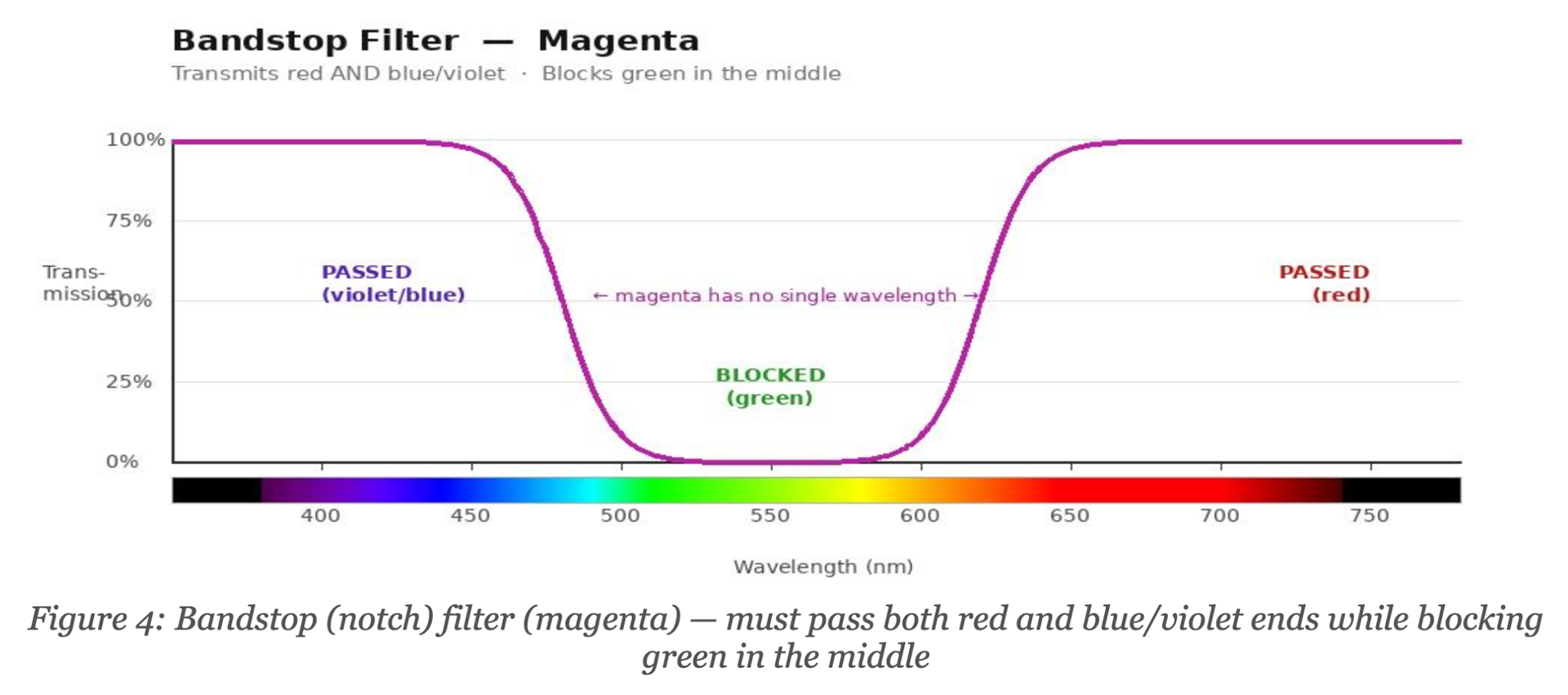
Figure 4: Bandstop (notch) filter (magenta) — must pass both red and blue/violet ends while blocking green in the middle
Yellow: The Colour With Two Identities
Yellow occupies a uniquely interesting position because it exists in both worlds simultaneously. Spectral yellow — light at approximately 570 to 590nm — is a real wavelength. It appears in rainbows. You can produce it with a prism, or a low-pressure sodium street lamp emits almost pure 589nm light — one of the most spectrally pure light sources in everyday life. In this form, yellow is as physically concrete as red or green.
But yellow also exists as a perceptual mixture. When red and green cone cells in the eye are stimulated together in the right proportions, the brain interprets the result as yellow — identical in appearance to spectral yellow, indistinguishable by any amount of looking. This is how computer monitors and phone screens produce yellow: there are no yellow pixels in an LED or OLED display. The screen simply fires red and green subpixels simultaneously, and your visual system is completely fooled.
Unlike magenta, which has no spectral version at all, yellow has a foot in both worlds. A yellow filter deals with real wavelengths — around 570nm and above — not a perceptual construction. But the yellow you perceive from your monitor is as brain-generated as magenta. The two yellows are physically entirely different, yet perceptually identical. This is one of the stranger facts about human colour vision.
The Errors in Educational Material
Given how counterintuitive some of this is, it is perhaps unsurprising that educational resources frequently get it wrong — and once an error is written down in an accessible source, it tends to propagate across the internet endlessly.
One of the most common errors is listing magenta as if it were a spectral colour with an associated wavelength. Some sources assign it a wavelength in the violet range (where it vaguely resembles violet to casual inspection). Others tack it onto the end of a spectrum table as a way of explaining why the colour wheel cycles back from violet to red. Both approaches are misleading. Magenta has no wavelength, and adding one to a table is simply wrong.
A related error is conflating violet and magenta. They are different colours. Violet is a real spectral colour covering roughly 380 to 450nm. Magenta is distinctly pinker and redder, and as established, has no wavelength at all. The confusion likely arises partly from their visual similarity in some contexts and partly from sloppy use of colour names.
Another common simplification is treating filters as if they have hard cutoffs — as if a red filter passes exactly wavelengths above 620nm and blocks everything else to zero. This binary model is convenient for explaining the concept but misrepresents how filters actually work. The gradual transmission curve matters in practice, and the incomplete blocking of 'rejected' wavelengths can affect results, particularly in photography.
The broader issue is that colour is a genuinely complex topic sitting at the intersection of physics, optics, neurophysiology, and perception — and simplifications that work well enough at a surface level can actively mislead when you try to go deeper. The fact that colour is partly a physical phenomenon and partly a construction of the brain is not a minor footnote; it is fundamental to understanding why filters behave the way they do.
Practical Implications for Black and White Photography
For black and white photography, colour filters work by selectively brightening or darkening tones according to the colour of the original subject. Because a black and white image records luminance rather than colour, a filter that blocks the wavelengths reflected by a subject will render that subject darker in the final image, while a filter that passes those wavelengths will render it lighter.
A red filter creates the most dramatic results: blue sky becomes very dark (blue light is blocked), white clouds stand out starkly, red subjects become very pale, and foliage can go dark. A yellow filter gives a more natural and subtle version of the same effect — a modest darkening of sky, slightly enhanced cloud contrast, a pleasing rendition of skin tones. A green filter brightens foliage while slightly darkening sky, useful for landscape and botanical work. A blue filter produces effects that are less often sought after in traditional photography — haze is emphasised, warm subjects darken — but can be used for creative effect or technical correction.
Understanding the physics behind these effects — long-pass versus short-pass behaviour, transmission curves rather than hard cutoffs, the difference between spectral and non-spectral colours — gives the photographer a far more intuitive sense of what any given filter will do to any given scene. It moves the use of filters from memorised rules ("red filter for dramatic skies") toward genuine understanding that can be applied creatively and flexibly.
Digital Sensors and Screens: More Like Eyes Than You Think
It is tempting to think of a digital camera sensor as a precise scientific instrument that measures wavelengths of light accurately and completely. In reality, a digital camera sensor works in a way that is strikingly similar to the human eye — and shares many of the same limitations and blind spots.
A typical colour digital sensor uses a Bayer filter mosaic — a grid of tiny colour filters placed over individual photosites on the sensor, with roughly half the photosites covered by a green filter, a quarter by red, and a quarter by blue. Each photosite measures only the intensity of light in its own colour channel. The sensor has no yellow photosites. It has no orange photosites, no cyan photosites, no magenta photosites. Like the three cone types in the human eye, the sensor captures the entire range of colour using only three channels — red, green, and blue — and everything else is inferred.
When a beam of pure spectral yellow light at 580nm strikes the sensor, no photosite reports 'yellow.' Instead, the red-filtered photosites and green-filtered photosites both respond partially — because 580nm light falls in the overlapping sensitivity range of both — and the camera's processing software interprets this combination of red and green signals as yellow. This is exactly the same mechanism by which the human eye perceives yellow: the long (red) and medium (green) cone cells are both stimulated, and the brain calls the result yellow. The camera and the eye are making the same educated guess.
Computer and phone screens exploit this same limitation. An LCD or OLED display has no yellow pixels — only red, green, and blue subpixels. To show yellow on screen, it simply activates the red and green subpixels at full or near-full brightness and leaves the blue subpixel off. The viewer's visual system is completely deceived: the stimulation of red and green cones produces a sensation of yellow indistinguishable from looking at a 580nm light source. The screen is not producing yellow light; it is producing a perceptual shortcut that the brain interprets as yellow.
This has an important implication: the colour you see on a screen is always a construction, never a direct representation of wavelengths. A photograph of a yellow flower displayed on a monitor does not show you 580nm light. It shows you red and green light mixed together in a ratio that your brain decodes as yellow. Whether this matters depends on context — for most purposes the perceptual result is identical — but it becomes significant in colour-critical work, scientific imaging, or any situation where the physical wavelengths themselves are what matters rather than just the appearance.
There is also a consequence for how digital cameras handle colour filters. When you place a red filter on a lens and photograph a scene, the red channel of the sensor receives strong signals while the green and blue channels are largely starved of light. The camera's processing interprets this imbalance and produces a heavily red-biased image. In black and white conversion, this translates directly to the tonal relationships familiar from film-era filter work. But because the sensor is operating on those same three imprecise, overlapping channels — not on discrete wavelength measurements — there is an inherent looseness in how it responds to a filter's transmission curve. The result is very good, but it is still a three-channel approximation of a continuous spectrum, just as the eye is.
Specialist scientific cameras do exist that capture more than three channels — multispectral and hyperspectral cameras can record dozens or even hundreds of narrow wavelength bands separately, giving a true spectral measurement of a scene. These are used in remote sensing, medical imaging, and art conservation. But the cameras used in everyday photography, including professional cameras, are fundamentally trichromatic devices, built on the same three-channel logic as the eye — and just as unable to detect a 'pure' yellow wavelength directly.
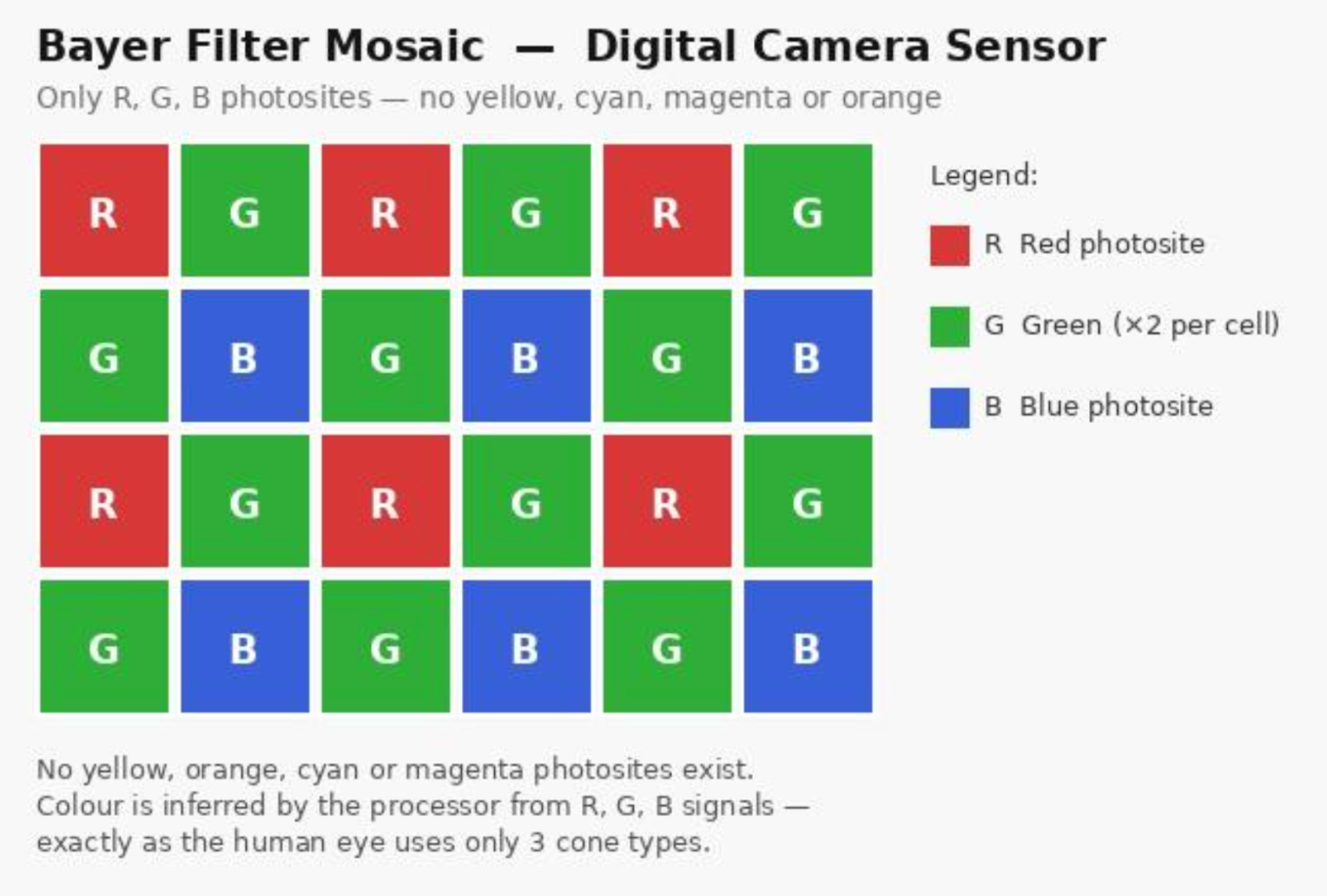
Figure 5: Bayer filter mosaic — a digital sensor contains only red, green and blue photosites; all other colours are inferred by the processor
The Primary Colour Muddle: Three Systems, One Confusion
Few topics in colour education cause more confusion than primary colours — and the confusion is almost entirely caused by three incompatible systems being taught as if they were the same thing. Depending on which textbook, which art class, or which website you consult, you may be told that the primaries are red, yellow and blue; or red, green and blue; or cyan, magenta and yellow. All three answers are given with equal confidence, and all three are correct in their own context.
The traditional artist's primaries — red, yellow, and blue — come from centuries of painting and pigment mixing. In this model, orange, green, and violet are the secondaries. This is the system most people learn as children and it has enormous cultural inertia. Unfortunately it is also the least physically defensible of the three. You cannot mix a saturated green from red, yellow, and blue pigments, and the model offers no real explanation for why these particular three colours are foundational. It is a practical approximation that painters found useful, not a description of how colour actually works.
The light primaries — red, green, and blue (RGB) — are physically grounded in human biology. They correspond approximately to the peak sensitivities of the three cone types in the human eye. Mix red and green light and you get yellow. Mix green and blue and you get cyan. Mix red and blue and you get magenta. Mix all three at full intensity and you get white. This is the additive system, and it is how screens, projectors, and the camera sensor's Bayer mosaic all work. The secondaries in this system are cyan, magenta, and yellow — which immediately tells you something important: yellow, which was a primary in the artist's model, is a secondary here, produced by combining red and green.
The print primaries — cyan, magenta, and yellow (CMY) — form the subtractive system used in colour printing and photography. Where the additive system works by adding light, the subtractive system works by removing it. A cyan ink absorbs red light and reflects everything else. A magenta ink absorbs green. A yellow ink absorbs blue. Combine all three and in theory you absorb all light and get black — in practice printers add a dedicated black ink, giving the familiar CMYK. The secondaries in CMY are red, green, and blue — the very colours that are primaries in the RGB system.
This is where the connection to our earlier discussion becomes vivid. Magenta — which we established has no wavelength and exists only as a perceptual construction — is a primary colour in both the CMY printing system and appears as a secondary in RGB (red and blue light combined). Meanwhile yellow — which has a genuine spectral wavelength at around 570 to 590nm — is a secondary in RGB (red and green light combined) and a primary only in the traditional artist's model, the least physically rigorous of the three systems. The colour with no physical existence is treated as more fundamental than the colour with a real wavelength. The physics and the colour models point in almost opposite directions.
For photography, the relevant system is CMY. Colour negative film records an image through three dye layers — a cyan dye layer, a magenta dye layer, and a yellow dye layer — each formed in response to the red, green, and blue light that exposed the film respectively. The yellow dye layer forms where blue light was present, absorbing blue in the final print to allow red and green to come through and produce the appearance of yellow. This is genuinely subtractive colour at work, and it explains why colour film is described as being able to record the spectral character of yellow faithfully: the dye system responds to the actual wavelengths that struck it, rather than making a three-channel digital approximation after the fact.
The confusion between the three primary colour systems is so widespread that even otherwise reliable educational sources routinely mix them up — treating RGB as universal, or presenting the artist's red-yellow-blue model as scientific truth. Understanding which system applies in which context is one of the more practical pieces of colour literacy a photographer can have.
Conclusion
Light is stranger and richer than it first appears, and so is colour. Some colours are real wavelengths, measurable and objective. Some are inventions of the brain, conjured from combinations of signals that have no single physical counterpart. Some are both, simultaneously, depending on their source. Filters engage with this physical reality — their transmission curves shaping which wavelengths reach the sensor, with all the subtlety of gradual slopes rather than binary switches.
The errors in textbooks and online resources are understandable but worth correcting — not for pedantry's sake, but because the true picture is more interesting than the simplified one. Magenta being a colour that does not physically exist, yellow being a colour that can be simultaneously real and invented, a filter being a curve rather than a wall, and primary colours meaning three entirely different things depending on which system you are in: these are not obscure technicalities. They are the foundations of understanding why photography with colour filters produces the results it does.